
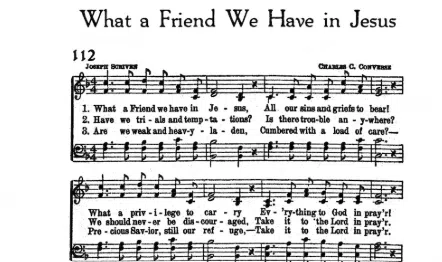
About “What a Friend We Have in Jesus” Song
“What a Friend We Have in Jesus” is a timeless Christian hymn that has comforted generations with its simple yet profound message of prayer and trust. The lyrics were written by Joseph Scriven, while the melody was later composed by Charles Crozat Converse.
First penned as a poem in 1855 and set to music in 1868, the hymn belongs to the Christian hymn / gospel genre. Over time, it has become one of the most widely sung hymns across denominations, known for its deeply personal tone and pastoral reassurance.
Lyrics
[Verse 1]
What a Friend we have in Jesus,
All our sins and griefs to bear!
What a privilege to carry
Everything to God in prayer!
O what peace we often forfeit,
O what needless pain we bear,
All because we do not carry
Everything to God in prayer!
[Verse 2]
Have we trials and temptations?
Is there trouble anywhere?
We should never be discouraged,
Take it to the Lord in prayer.
Can we find a friend so faithful
Who will all our sorrows share?
Jesus knows our every weakness,
Take it to the Lord in prayer.
[Verse 3]
Are we weak and heavy-laden,
Cumbered with a load of care?
Precious Savior, still our refuge—
Take it to the Lord in prayer;
Do thy friends despise, forsake thee?
Take it to the Lord in prayer;
In His arms He’ll take and shield thee,
Thou wilt find a solace there.
NOTE: Lyrics are the property of their respective owners and are shared here for educational, commentary, and review purposes.
Song Overview & Analysis
At its core, What a Friend We Have in Jesus presents Jesus not as a distant religious figure, but as an intimate, ever-present companion. The song’s mood is gentle, consoling, and reflective, carrying a quiet emotional weight rather than dramatic intensity. Its language is plain and conversational, which is a major reason it resonates so strongly across cultures and eras.
Mood & Style
The hymn’s mood is one of calm reassurance. There’s no urgency or fear-driven faith here—just an invitation to rest. Musically, the melody is smooth and hymn-like, designed for communal singing. Lyrically, the repetition of phrases like “Take it to the Lord in prayer” reinforces the central practice of faith as something lived daily, not reserved for moments of crisis alone.
Verse-by-Verse Meaning
Verse 1 introduces the central theme: the contrast between peace available through prayer and the pain we carry when we choose not to pray. The wording suggests that suffering is often “needless”, not because life is easy, but because believers forget to share their burdens with God. It frames prayer as both a privilege and a release.
Verse 2 shifts toward life’s struggles—trials, temptations, trouble. Instead of denial or false optimism, the verse acknowledges hardship as universal. The rhetorical question “Can we find a friend so faithful?” emphasizes Jesus’ reliability, portraying Him as someone who not only listens but understands human weakness fully.
Verse 3 becomes more intimate and emotional. Words like “weak,” “heavy-laden,” and “forsake” speak to isolation, rejection, and emotional exhaustion. The imagery of being taken into Christ’s arms suggests protection, warmth, and s olace—ending the hymn on a deeply comforting note.
Themes & Takeaways
- Prayer as emotional refuge, not obligation
- Jesus as friend, not just savior or judge
- Shared suffering, emphasizing empathy and understanding
- Peace through surrender, rather than self-reliance
Overall, the hymn’s enduring power lies in its emotional honesty. It doesn’t promise a life without pain—it promises companionship within it. That balance of realism and hope is what continues to make the song meaningful more than a century later.





One Comment